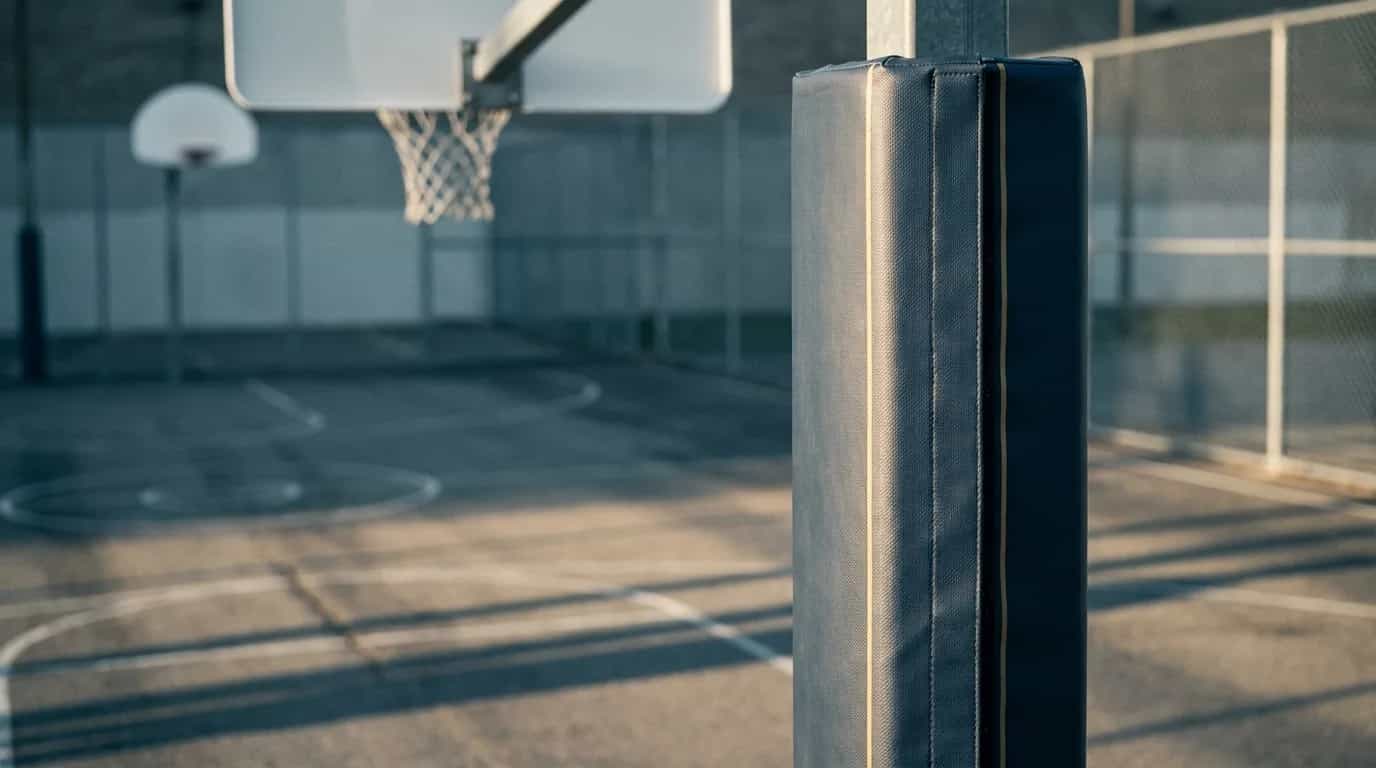
Built to order in Closter, New Jersey
Custom pole padsthat take the hitfor you.
Basketball post padding and gymnasium wall pads, built to your dimensions in 16 stock colors, printed with your logo, and shipped anywhere in the lower 48.
- 16 stock vinyl colors
- 2 in impact foam core
- Made to order
- 1-Year Limited Warranty
- Fits 4 in through 6 x 8 in posts
- Full-color logo printing
- Ships to all 48 contiguous states
- Purchase orders accepted
- 7/16 in plywood-backed wall panels
- Indoor and outdoor builds
The case for padding
A steel post does not
care how fast
the play was.
Basketball ends at the baseline, but players do not. They arrive at the post at full speed, off balance, looking back at the ball. The post is a fixed steel object with no give in it at all, and it is usually the closest hard thing to the most contested part of the floor.
The rulebooks have understood this for a long time. NFHS basketball rules call for at least 3 feet, and preferably 10 feet, of unobstructed space outside the boundaries. Where that space does not exist, padding is what stands in for it.
What the rulebooks actually say
- NFHS, portable backstops
- Bases must be padded to a height of 7 feet on the court-side surface. This one is a requirement, not a suggestion.
- ASTM F2440, indoor wall padding
- Sets impact limits of 200 Gmax and 1000 HIC, and says pads should sit no more than 4 inches above the playing surface.
- NCAA basketball
- Padding is recommended rather than mandated. Worth knowing that NCAA softball moved to a hard requirement for padded hard-material backstops effective 1 January 2027.
The range
Eleven builds.
One set of standards.
Prices shown are the starting point for a stock configuration. Custom sizes, printing and colors are quoted per project.
- FT75FT75 Pole Pad, 4 in and 5 in SquareWraps 4 in and 5 in square posts and most round posts on residential and park systems.Fits 4" and 5" square posts, most round postsfrom $254
- FT77FT77 Base and Gusset PadCovers the angled gusset and base plate, the part of the system players actually trip over.Fits Standard gusset and base plate assembliesfrom $146
- FT78FT78 Pole Pad, 6x6 SquareThe standard institutional pad for 6 in square posts on school and park systems.Fits 6" x 6" square postsfrom $307
- FT79FT79 Pole Pad and Gusset, 6x6 SquareTwo-piece set that pads the post and the gusset together, shipped as a matched pair.Fits 6" x 6" square posts with gussetfrom $402
- FT80PFT80P Pole Pad, 6x8Post pad only for 6 in by 8 in crank-adjustable systems. Gusset pad ordered separately.Fits 6" x 8" crank-adjustable postsfrom $291
- FT80FT80 Pole Pad and Gusset, 6x8The complete 6 in by 8 in set. Post pad and gusset pad, matched and shipped together.Fits 6" x 8" crank-adjustable posts with gussetfrom $436
- FT456-FOFoam-Only Wall PadLighter wall panel for surfaces that are already flat and solid enough to take direct mounting.Fits Flat, solid wall surfacesfrom $152
- FT456-WBPlywood-Backed Wall PadRigid panel that spans uneven block and holds its shape under repeated contact.Fits Block, brick and uneven wall surfacesfrom $172
- HI-GRAPHICPrinted Graphic Wall PaddingDigitally printed panels that turn a safety requirement into your school's identity wall.Fits Standard 2 ft x 6 ft and 2 ft x 8 ft, custom sizes availableQuoted
- CPP-CUSTOMCustom Printed Pole PadYour wordmark, mascot or sponsor logo applied to a stock-colour pad and installed before it ships.Fits 4", 5", 6x6 and 6x8 postsfrom $373.99
- CPP-DECALPole Pad Decal and ApplicationAdds lettering or a logo to pads you already own, applied by us rather than shipped loose.Fits Existing pole pads in serviceable conditionfrom $119.99
Stock colors
Sixteen colors,
no upcharge.
These are stock vinyl colors, held in inventory and priced the same as one another. If your program runs a color that is not on this wall, we print it instead of trying to talk you into something close.
- Black
- Navy Blue
- Royal Blue
- Columbia Blue
- Scarlet
- Brick Red
- Maroon
- Orange
- Sienna Orange
- Gold
- Desert Gold
- Kelly Green
- Forest Green
- Purple
- Grey
- Saddle Brown
Colors on this page are screen approximations of dyed vinyl. Monitors vary, and vinyl does not render the same way twice. For anything that has to match an existing uniform, floor or wordmark, ask us for a physical swatch before you approve the order.
Construction
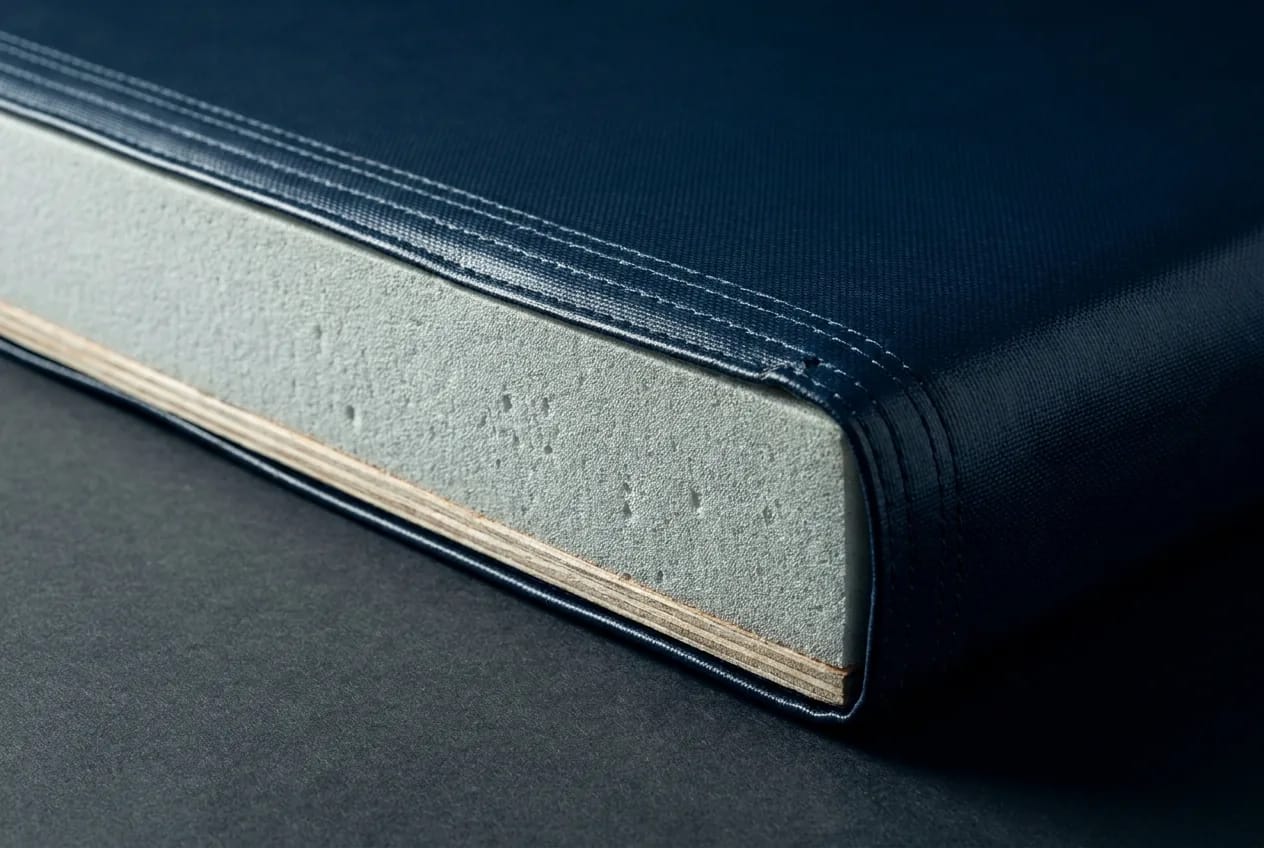
Four layers.
Nothing decorative.
Outer skin
Heavy-duty coated vinyl
Wraps the whole assembly and takes every point of contact. Treated for mildew and UV so an outdoor pad does not chalk and stiffen after one season.
Core
2 in impact foam
The part that actually does the work. Thickness is only half the story: what matters is how the foam resists deflection, which is why pads have to be judged as a finished unit rather than by foam density alone.
Backing
7/16 in plywood, where it earns its place
Rigid backing spans uneven block and keeps the panel flat under repeated contact. On flat, sound walls a foam-only panel is lighter, cheaper and just as effective.
Closure
Full-length hook and loop
Pads wrap and close on themselves, so they go on without drilling the post and come off for storage, repair or a rebrand.
On ASTM F2440
F2440 is the specification for impact attenuation of indoor wall padding. It sets limits of 200 Gmax and 1000 HIC and calls for pads to be mounted no more than 4 inches above the floor. If your specification requires documented test results against it, ask us and we will tell you plainly what we can and cannot document for the build you need.
Read the full materials guideHow an order runs
Five steps,
no surprises.
- 01
Measure
Square posts get all four sides measured independently. Round posts get a tape around the circumference divided by 3.14, rounded up if it lands between sizes. There is no universal post size in this industry, so guessing is what causes returns.
Measuring guide - 02
Specify
Pick a color from the stock wall, decide indoor or outdoor, and choose foam-only or plywood-backed for wall panels. We will tell you which one your wall actually needs rather than defaulting to the more expensive one.
See the colors - 03
Proof
Send artwork as vector where you can. We return a proof showing placement and scale on the actual pad size, and nothing goes into production until you have approved it in writing.
Printing options - 04
Build
Cut, wrap and stitched to your dimensions. Because these are made to order rather than pulled from a shelf, lead time depends on the configuration and the season, and we quote it honestly up front.
- 05
Ship or install
Freight anywhere in the lower 48. In New Jersey, New York, Connecticut, eastern Pennsylvania and our Texas markets, our own crews can handle the install instead.
Installation areas
Who we build for
Same product.
Six different
approval paths.
Most common
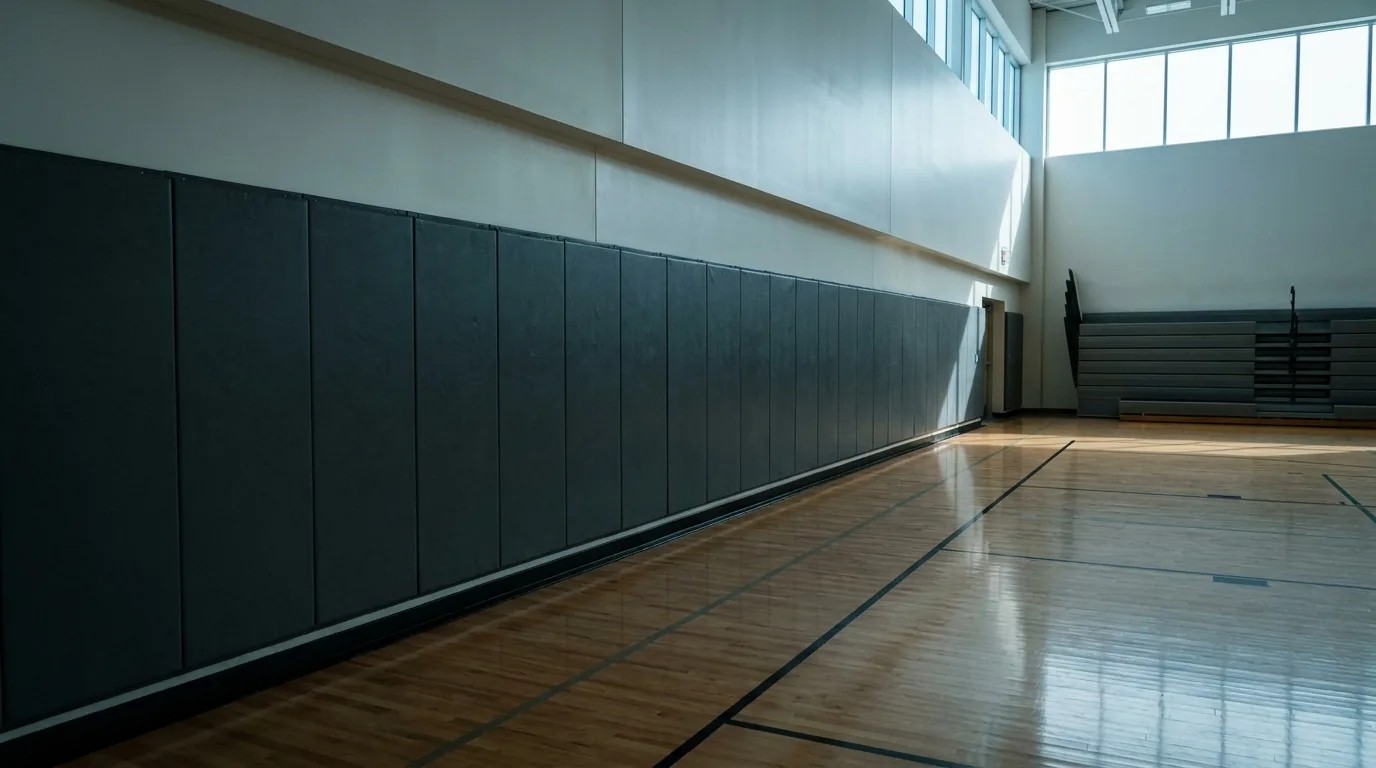
Schools and districts
Most of what we build goes into a school gym. That means we already work the way your business office does: written quotes, purchase orders, W9 on request, and a lead time you can put in front of a board.
School paddingChurches and ministries
Halls that host a game on Friday and a service on Sunday. Removable pads matter more here than anywhere else.
Parks and recreation
Outdoor courts that live under UV, rain and freeze-thaw, with no one on site to bring anything indoors.
Colleges and universities
Padding that has to match an identity system with a real style guide, down to the specified color.
Clubs and academies
High-traffic training floors where padding is also the surface sponsors are paying to appear on.
HOAs and communities
A board, a reserve study and an insurance carrier. The paperwork matters as much as the product.
How do I measure for a basketball pole pad?
For a square post, measure all four sides independently, because posts are not always square. For a round post, wrap a tape around it and divide the circumference by 3.14. If the result falls between two sizes, round up. There is no universal post size in this industry, so measuring beats assuming.
How much does a custom basketball pole pad cost?
Stock pole pads start at $146 for a base and gusset pad and run to $436 for a complete 6 by 8 inch set. Custom printed pads start around $374. Final pricing depends on post size, indoor or outdoor build, and whether you are adding lettering or a full logo.
What is the lead time on custom pole pads?
Stock items generally ship within two to three business days. Custom printed pads take longer because artwork has to be proofed and approved before anything is cut. We put a specific lead time in writing on every quote rather than making you chase it, and we tell you if a date is at risk.
Do you accept school purchase orders?
Yes. We work with school districts, universities, parks departments and municipalities on purchase orders, and we can provide a W9 and a formal written quote for your business office. Tell us what your requisition process needs and we will format the paperwork to match it.
How thick should gymnasium wall padding be?
Two inches is the working standard for indoor gym walls. Thickness alone does not determine safety though. What matters is how the finished pad resists deflection under impact, which is why padding should be evaluated as a complete assembly rather than by foam thickness or density in isolation.
What is ASTM F2440?
ASTM F2440 is the specification for impact attenuation of wall padding in indoor sports venues. The current edition is F2440-24. It sets limits of 200 Gmax and 1000 HIC, and calls for padding to be mounted no more than four inches above the playing surface.
What is the difference between plywood-backed and foam-only wall pads?
Plywood-backed panels have a rigid board behind the foam, so they span uneven block walls and hold their shape under repeated contact. Foam-only panels are lighter and cost less, and they work well on walls that are already flat and sound. We will tell you which one your wall needs.
Do pole pads fit both round and square posts?
Yes, though they are different products. Our 4 and 5 inch pad also fits most round posts, while 6 by 6 inch and 6 by 8 inch pads are built specifically for square and rectangular posts. Send us your measurements and we will confirm the fit before you order.
What artwork do you need for a printed pole pad?
Vector artwork is best, in EPS, AI or PDF format, with fonts converted to outlines. If you only have a raster file, send it at 300 dpi at final print size. We return a proof showing placement and scale on your actual pad before anything goes into production.
Do you install, or do you only ship?
Both. We ship to all 48 contiguous states. Our own installation crews cover New Jersey, New York, Connecticut, eastern Pennsylvania, and the Austin and Houston markets in Texas. Outside those areas, pole pads wrap and close with hook and loop, so most facilities install them without a contractor.
Start a quote
Send us the
measurements.
Tell us the post size or the wall run, the colors you need, and whether it lives indoors or out. You will get a written quote back with a real lead time on it.
- A written lead time on every quote
- Purchase orders and W9 on request
- A proof before anything is cut